

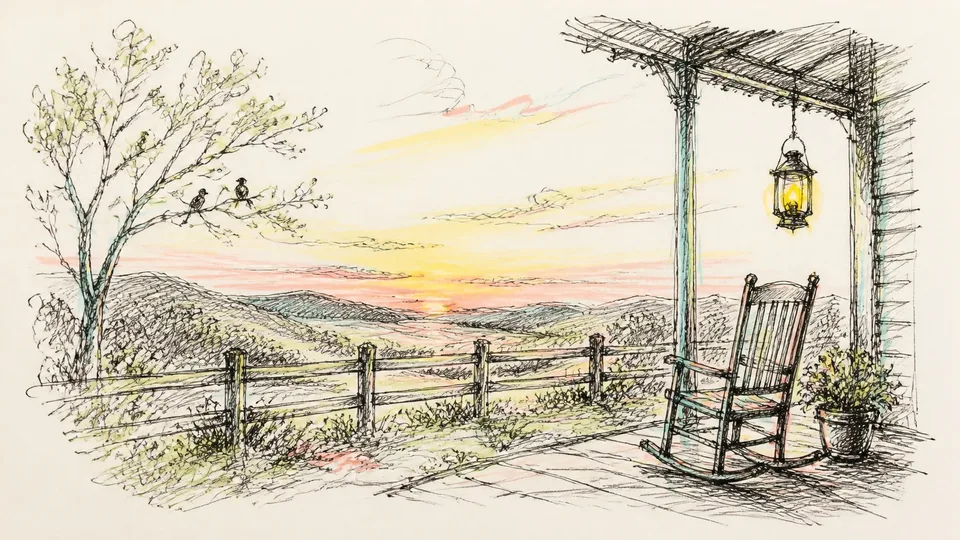
Dusk is the part of the day that does not ask us to choose between bright and dark. It gives the eye a little time to adjust, softening rooftops, trees, and familiar faces. For many of us, that brief hour is when the day's noise finally loosens its hold.
These poems about dusk are for a porch, a walk home, a quiet message, or a notebook opened after dinner. The collection includes two sonnets and three shorter forms, each looking at evening from a different angle. Some poems feel restful, while others hold the tender uncertainty that arrives when the light begins to leave.
I have always trusted the small work of twilight. It reminds me that an ending can be gradual, and that a room does not become empty simply because the sun has moved on. If you enjoy weather and changing light, you may also like these poems about the elements and these poems about walking.
Poems About Dusk
When Dusk Comes Down
This Shakespearean sonnet follows the first minutes when evening settles over a familiar street. Its fourteen lines use an ABAB CDCD EFEF GG rhyme pattern. The closing couplet treats dusk as a gentle invitation to release the day's unfinished work.
When dusk comes down, the roofs grow soft and gray,
The sparrows tuck their small complaints from sight,
A copper hush replaces heat of day,
And windows gather pools of patient light.The road remembers every hurried shoe,
Yet now it lets the tired footsteps slow,
A porch lamp makes one circle warm and true,
While distant hills turn violet below.I hold the things I could not mend or say,
Then set them by the teacup for the night,
The heart can rest without a clear display,
And still be learning how to choose the right.Let evening keep what daylight could not do,
Tomorrow has a little room for you.
First Evening Star
This haiku gathers dusk into one first point of light. It uses a checked five, seven, five syllable pattern, keeping the feeling brief and clear.
First star warms the blue
Birds fold their songs in green leaves
Day rests in the hills
The Lantern of the West
This Petrarchan sonnet begins with an ABBA ABBA octave and resolves through a six line sestet. The western sky becomes a lantern that does not erase sorrow, but gives it a kinder outline.
The western sky grows quiet as a flame,
A narrow gold along the cooling air,
The day's bright questions loosen from their care,
And shadows learn the kindness of a name.I walk the yard and hear the evening claim
Each leaf, each gate, each chair left waiting there,
The world is not diminished by repair,
Nor is a tired heart diminished by its shame.The dark will come, but not as sudden stone,
It gathers like a shawl around the land,
It leaves a little threshold of its own,
Where I can breathe and let my worries stand.One star appears, a small and steady art,
A pin of light sewn gently through the heart.
At the Fence Line
This free verse poem pauses beside a fence while the last light changes ordinary objects. Its open line lengths make room for the mind to wander without forcing the moment into a rhyme.
At the fence line,
the weeds turn silver.A moth makes one uncertain circle
around the porch bulb.I have carried the day
like a basket with a broken handle.Dusk sets it down for me,
gently,
beside the gate.
The Last Light on the Steps
This blank verse poem keeps a measured, unrhymed movement. It follows a person sitting on the steps long enough to notice that quiet is not the same as loneliness.
The last light rests along the wooden steps.
I hear the kitchen settling into night.
A neighbor closes up the garden gate.
The evening air has room for every sound.
I count the boards beneath my careful feet.
The day is gone, yet nothing asks me to
Become a different person in the dark.
I bring my questions in and let them sit.
The first cool star appears above the roof.
I rise when I am ready, not before.
Letting the Day Grow Quiet
Dusk can be useful when a person needs a softer border around a difficult day. It does not solve a problem, but it can change the pace at which we carry one. A few minutes of purple light may be enough to remind us that rest belongs in the story too.
Choose When Dusk Comes Down for a note to someone who is finishing a long day. The haiku fits a small caption or journal entry, while The Lantern of the West suits a slower reading beside a window. At the Fence Line is for anyone who needs permission to set down a burden without explaining it.
If you share one of these poems, add a real detail from your own evening. Name the color on a wall, the sound of a screen door, or the place where the first star appeared. Specific attention turns a general poem into a small home for memory.
The light will keep changing whether we are ready or not. Dusk gives us a graceful way to practice that truth. We can let one day close with some questions unanswered, trusting that the next morning will bring a different kind of seeing.
Send a little poetry to someone you love.