
The cowboy image can be larger than a hat, a horse, or a long road. At its heart are weather, patience, practical work, and the ability to read a landscape before making a choice. A wide horizon can hold loneliness, but it can also hold responsibility and belonging.
These poems about cowboys include two sonnets, a ballad, free verse, and a villanelle. They are written for readers who love western stories, open country, horses, or the quiet dignity of work done without an audience.
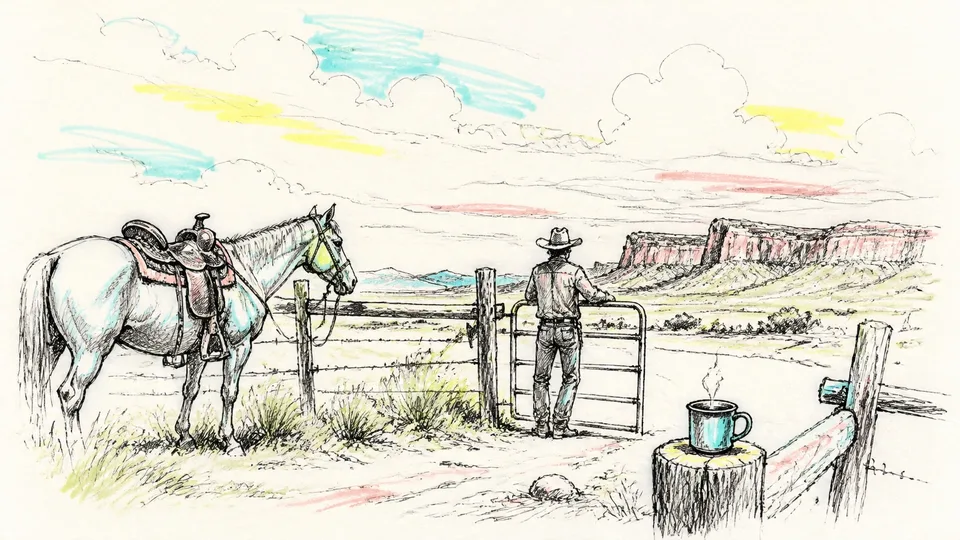
The western sky has a way of making small details stand out. A gate latch, a coffee cup, a horse's breath, or a storm beyond the rimrocks can become the center of a whole morning. If you enjoy poems about travel and place, you may also like these poems about road trips and these poems about walking.
Poems About Cowboys
Under a Western Sky
This Shakespearean sonnet uses an ABAB CDCD EFEF GG rhyme pattern. It treats the cowboy as a careful reader of weather and animals, while the final couplet turns courage toward ordinary responsibility.
Under a western sky, the morning spreads,
A blue so wide it makes the fences small,
The horse breathes silver where the cold wind treads,
And distant thunder gathers past the wall.A hand checks leather, cinches, gate, and grain,
The work begins before the sun is high,
No boast is needed for a falling rain,
No borrowed story makes the horses shy.The trail can turn, the dry grass can deceive,
A rider learns to listen to the ground,
To leave a little room for what will grieve,
And keep the living creatures safe and sound.The widest courage is the quiet kind,
That keeps both reins and promises in mind.
The Gate at Morning
This ballad follows a rider checking a gate before a storm. Its song like movement makes the practical act of securing a pasture feel like a small promise to the animals and the land.
The clouds came low above the rim,
The wind began to rise.
A rider rode the northern fence
Beneath the darkening skies.One hinge was loose, one post was split,
The grass was sharp and dry.
The rider fixed the gate in time,
Then watched the thunder fly.The storm came hard, the horses stayed,
The fence held through the night.
At dawn, the rider checked the field
And found the world all right.
The Horse Knows the Way
This second sonnet uses an ABBA ABBA octave and a six line resolution. The horse becomes a partner with its own attention, not a prop, and the speaker learns to travel through trust.
The horse knows where the narrow creek bed bends,
It lifts one hoof above the broken stone,
And finds a path the rider calls unknown,
Then waits until the breathing road extends.The trail is made of weather, not of ends,
Of grass laid down, of shadows overgrown,
Of patience learned by leaving fear alone,
Of hands that speak before the rider sends.I loosen both the reins and my demand,
I let the animal choose where to go,
The trust between us settles in the land,
A quiet answer neither needs to show.We travel far by listening more than force,
Two lives aligned along a changing course.
The Coffee Tin
This free verse poem gives a cowboy morning a domestic center. The short lines make the coffee tin, the cold, and the first light feel as important as the open range.
The coffee tin is dented.
The cup is blue.
Outside,
the horse shifts weight
beneath a sky the color of steel.I pour the first cup
and listen for weather.Work waits.
So does the morning.
The Rider Returns at Dusk
This villanelle uses nineteen lines, two repeated refrains, and two rhyming sounds. Its refrains follow a rider returning through changing weather and make home feel like a place of repeated care.
The rider comes home when the long light falls.
The horse knows every turn beside the wall.
A quiet hand can answer distant calls.The wind has moved the dust across the stalls,
The gate stands firm, the shadows gather tall.
The rider comes home when the long light falls.A lantern wakes in one of the small halls,
A kettle sings beyond the wooden wall.
A quiet hand can answer distant calls.The day has asked for work, and work recalls
The names of every creature in the stall.
The rider comes home when the long light falls.No grand return is needed after all,
Just boots, a breath, and someone saying “all.”
A quiet hand can answer distant calls.The rider turns the latch, the evening calls,
The sky grows dark, the porch light starts to fall.
The rider comes home when the long light falls.
A quiet hand can answer distant calls.
The Work Beneath the Legend
Cowboy poems can carry a romantic picture of the West, but the strongest images include the work beneath the legend. Caring for animals, reading weather, fixing a gate, and returning home are forms of courage that do not need a spotlight.
Use Under a Western Sky for a western themed reading or a note about steady work. The Gate at Morning suits a story about responsibility, while The Horse Knows the Way honors partnership and trust. The Coffee Tin is a small morning sketch, and the villanelle fits a homecoming.
If you share one of these poems, add a true detail from the landscape that matters to you. Name the grass, the fence, the weather, or the sound of a horse moving in a stall. Specific place keeps the wide sky from becoming a stage set.
The road may be open, but no one travels it alone. A careful hand, a reliable animal, and a light in the window can make the biggest country feel like home. That is the kind of western story worth carrying forward.
Send a little poetry to someone you love.