

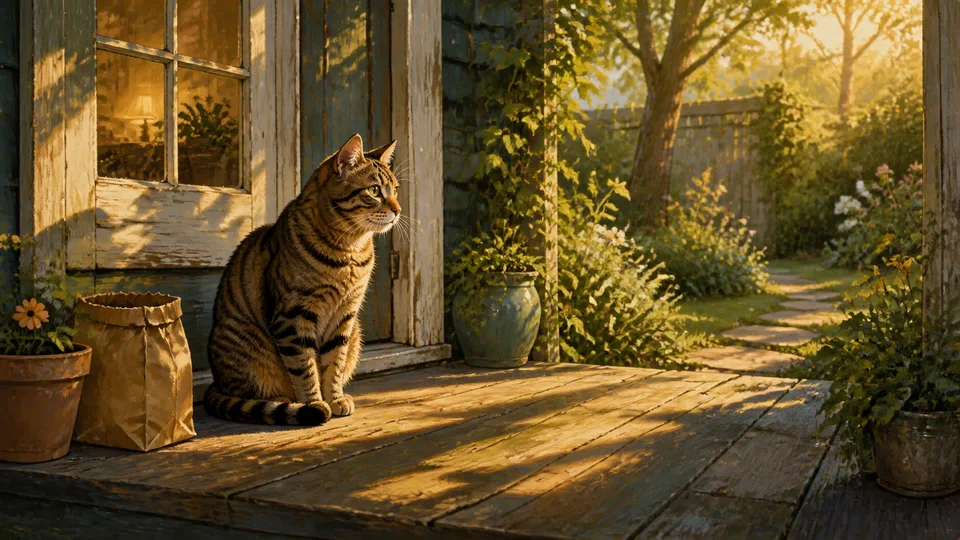
Cats have a way of making an ordinary room feel like a place with secrets. They study a windowsill, patrol a hallway, and decide that the middle of a book is the proper place for a nap. Their affection may be quiet or sudden, but it often arrives with a warm body leaning close when we were not asking for comfort.
These poems about cats notice the small negotiations of shared life. A cat offers companionship without a schedule, curiosity without an explanation, and a reminder that rest is not a character flaw. The collection includes a story, a haiku, free verse, and two sonnets so the forms can move as lightly as a cat from one room to another.
I have always admired the way cats make room for wonder. A paper bag becomes a cave, a sunbeam becomes a destination, and a bird outside the glass can hold complete attention. Their presence invites us to look again at the things we pass too quickly.
For another collection about gentle movement through the day, try these poems about walking. If you are writing for a friend who enjoys a warm morning message, these good morning poems for friends may also help.
Poems About Cats
The Window Seat
This Shakespearean sonnet gives a cat the dignity of a patient observer. Its fourteen lines follow an ABAB CDCD EFEF GG rhyme pattern. The final couplet turns the cat's quiet watch into a lesson for the human companion.
A striped cat warms the windowsill at noon,
The dust turns gold around her patient paws,
She listens to the rain's familiar tune,
Then blinks as if she knows the world's old laws.The sparrows hop beyond the shining pane,
A leaf goes skittering down the walk,
She watches clouds convene beyond the rain,
And makes a kingdom of her quiet talk.I bring my busy thoughts beside her chair,
She does not ask me why I hurry so,
Her steady breathing settles in the air,
A little patience teaches me to slow.The world is large, but home is near and bright,
When two calm hearts attend the afternoon light.
The Cat Who Came Before the Moon
This ballad tells a small nighttime story in song like quatrains. A repeating phrase gives it the feeling of a tale told more than once. The cat's adventure ends with a familiar return.
The porch was dark, the kettle cooled,
The evening lost its tune.
A small gray cat slipped through the gate
Before the rising moon.She followed moths beside the hedge,
She crossed the neighbor's yard.
The stars came out, the night grew deep,
The road was wide and hard.Then from the steps a soft bell rang,
A window showed one light.
She turned toward home, her tail held high,
And vanished into night.
Whiskers in the Dark
This second sonnet uses a loose Petrarchan opening with an ABBA ABBA pattern and a six line resolution. It considers the courage of curiosity without making the cat seem fearless. Even a brave explorer may choose the familiar blanket at the end.
When whiskers test the hallway after rain,
The house becomes a country made of sound,
Each shadow turns a doorway upside down,
Each creaking board is newly strange terrain.Yet soft paws cross the dark with careful grace,
A nose can read the stories cold air brings,
The smallest creature claims a larger place,
And listens for the rustle under things.By dawn the brave investigator knows
The safest map is where the warm lights fall,
A bowl, a chair, the blanket's folded rose,
The human voice that answers when we call.Curiosity may roam beyond the room,
But love keeps one familiar place in bloom.
Soft Paws Cross the Hall
This haiku is a small night image. It uses three lines with a checked five, seven, five syllable pattern. The cat is present mostly through motion and the way moonlight changes a room.
Soft paws cross the hall
Moonlight pools beneath the chair
Night keeps one bright eye
A Cat Makes a Window
This free verse poem uses open spacing to imitate a cat's attention moving from one detail to another. There is no fixed meter or rhyme scheme. The form leaves room for the pauses that make a quiet companion feel close.
The cat sits at the glass
as if the glass were a page.A moth writes one brief sentence.
The branch adds another.I stand behind her,
reading the weather
in the tilt of one ear.For a moment,
the window is not a barrier.
It is a way of seeing.
The Gift of Quiet Company
Living with a cat means learning that affection may not arrive on our preferred schedule. A cat may leave the room when we reach for it and return when we are finally absorbed in something else. This is not indifference. It is a different rhythm of trust, one that asks us to notice invitations instead of demanding performances.
The Window Seat is for the companion who watches the world beside you. The Cat Who Came Before the Moon makes a sweet story for a curious animal who has tested every boundary. Whiskers in the Dark honors a cautious explorer, while the haiku and free verse pieces can fit a short note or a private journal.
Cats also teach a practical kind of attention. They know where the warm patch of floor will fall, when the cupboard opens, and which sound means someone has come home. Their knowledge is not grand, but it is precise. We can borrow that habit and ask what the room is offering us today.
Whether a cat is curled beside you or remembered from another season, the ordinary details remain valuable. A bell at the door, a paw on the page, a sudden leap toward a paper scrap, or a quiet head against your hand can become part of the home’s language. I hope these poems help you hear that language with a little more wonder.
A toy for a little shared play
A favorite toy you already own is enough. If you want another interactive option, use this one with supervision and put it away after play.
These are paid links. As an Amazon Associate I earn from qualifying purchases.
- View on Amazon
Cat Dancer 101 interactive cat toy
Move the wire-and-cardboard toy during a short play session and notice the small leaps and curious movements celebrated in these poems.
One wire-and-cardboard interactive cat toy
Send a little poetry to someone you love.