

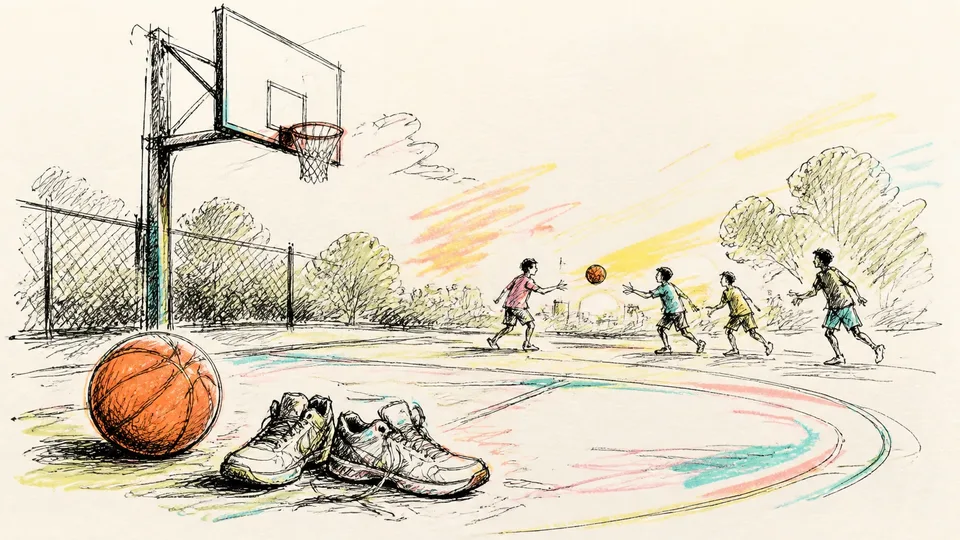
Basketball is a game of quick decisions and shared attention. A player may sprint, stop, pass, miss, recover, and try again within the space of one breath. The court teaches that individual skill matters, but so does the trust that lets a team move together.
These poems about basketball include two sonnets, a limerick, blank verse, and a haiku. They are for players, coaches, families in the bleachers, and anyone who remembers the sound of a ball meeting a polished floor.
I like the way a game makes effort visible. A missed shot can be followed by a rebound, a hand can reach down to help someone stand, and a quiet pass can change the whole direction of play. If you enjoy poems about athletic movement, you may also like these poems about soccer and these poems about dancing.
Poems About Basketball
The Court at Dusk
This Shakespearean sonnet uses an ABAB CDCD EFEF GG rhyme pattern. It notices the court after practice, when the noise fades and the lessons of effort remain.
The court at dusk still holds the players' feet,
A bouncing echo travels through the hall,
The painted lines make every angle meet,
And one last basketball rebounds from wall.The scoreboard dims, the bleachers settle down,
A towel lies beside a borrowed shoe,
The game has left a quiet on the ground,
Yet every tired hand remembers too.We learn to miss, to pass, to try once more,
To guard a space and trust another's call,
To find the open person near the door,
And rise together after we both fall.The final whistle cannot make us part,
The team keeps moving in the listening heart.
The Coach Who Called It Soup
This limerick follows five lines and an AABBA rhyme pattern. Its joke is about a coach whose motivational speech gets mixed up, then somehow brings the team together anyway.
A coach who was hungry for soup,
Told the team, “We must hustle and group.”
They passed with delight,
Made a basket just right,
And won with a ladle shaped hoop.
The Pass
This second sonnet uses an ABBA ABBA octave and a six line resolution. It treats a pass as an act of attention and generosity, not a surrender of individual talent.
The ball moves faster than the eye can see,
It leaves one hand and finds another's space,
A trust is measured in the turning pace,
A quiet “here” becomes a victory.I could have held the shining chance for me,
But saw a teammate open near the place,
And sent the ball toward that waiting grace,
Where skill became a shared possibility.The crowd may praise the shot that meets the net,
Yet every score is built by hands unseen,
By feet that run, by screens the bodies set,
By one clear pass that makes the lane grow clean.The game is larger than the name they say,
We win each other by the way we play.
The Floor Remembers
This blank verse poem listens to the court after the players leave. Its steady unrhymed lines make room for effort, memory, and the promise of another practice.
The floor remembers every sudden stop.
It holds the squeak of shoes and shouted names.
A line of dust lies near the baseline now.
The lights stay bright above the empty court.
Tomorrow, hands will meet the ball again.
Tonight, the quiet gathers what was learned.
A player carries one missed shot back home.
A teammate carries one encouraging word.
The court is still, but not the work of trust.
The game begins again inside the mind.
Orange Ball, Blue Evening
This haiku keeps a single ball in the last light. Its five, seven, five rhythm is short enough for a team card or a small note after practice.
Orange ball arcs high
Blue evening waits for the shot
Teammates call my name
What the Court Teaches
Basketball offers useful language for effort because it includes both failure and recovery. A player can miss and still rebound. A team can lose a point and still choose the next action. The game makes room for practice, humor, and trust.
Use The Court at Dusk for a coach, senior night, or a reflective team reading. The limerick can lighten a team note, while The Pass honors the quiet work of sharing a chance. The blank verse poem suits the end of a season, and Orange Ball, Blue Evening fits a short message after practice.
If you share one of these poems, name the part of the game that taught you something. It might be the first dribble, the bench, a hard rebound, or the teammate who stayed after the lights dimmed. Real details make teamwork visible.
The scoreboard records one kind of result, but the court teaches many others. Keep showing up, keep looking for the open person, and remember that the best play may be the one that helps someone else shine.
Send a little poetry to someone you love.