
Step Dad poems can be difficult to find when the feeling you want is appreciation rather than a birthday greeting. A relationship may have grown through rides, small repairs, shared jokes, or the simple discovery that a person keeps showing up without demanding a certain name.
I like poems that allow trust to have its own pace. There is no single word a child must use, no requirement to compare parents, and no need to make one family bond disappear before another can matter. A kind stepfather can have a place that is his own.
These five original poems speak from several imagined moments of growing familiarity. They are meant for a note, a family occasion, or an ordinary afternoon when you want to acknowledge care.
If the occasion is specifically his birthday, the Happy Birthday Step Dad poems offer that celebration. This collection stays with the everyday relationship, including the quiet boundaries that can make closeness feel possible.
Poems for the occasion
The Name I Choose
I feel the care in the space after the speaker tries a name. The response matters more than the label, and that seems a generous place for the poem to begin.
At first I called you nothing,
just waited until you looked up.Then your first name,
careful as a new key.You never corrected the shape of it.
Never held a larger word
in front of me like a prize.Now I call across the garden
without thinking first.
You turn.
That is part of what we built.
You Let the Silence Be
The unanswered question gives this poem its tenderness for me. I like that patience is shown as something active, a choice to stay available without pressing closer.
You did not ask a question every mile
Or fill the car with things I ought to say.
You let the passing fields unfold a while,
And kept the larger questions for some day.
You did not make my quietness a test
Or ask me which of us had earned a place.
You let the old affection have its rest,
And left the newer bond its growing space.
In time I told you something small and true;
You listened while a wider trust took root.
The shared affection found its own way through,
Without an order, deadline, or pursuit.
You waited while I found what I could say.
I learned that care could leave the latch that way.
The Saturday Hinge
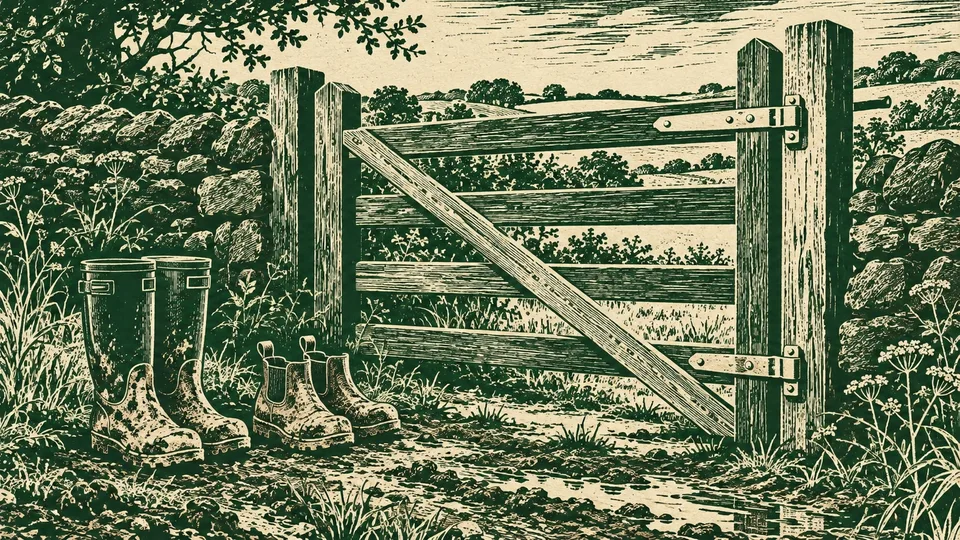
The gate is a modest project, which is why I like it. Two people can sometimes find a comfortable conversation while both are looking at the same loose screw.
The garden gate had scraped the path
Since early in the spring.
He brought a spanner from the shed;
I held the crooked thing.He asked me which way seemed the best;
I pointed toward the sun.
We tried my plan, then tried his plan,
And left the hinge half done.Next Saturday we worked again;
The gate swung smooth and wide.
We stood and watched it move a while,
Two helpers, side by side.
Side by Side
The muddy boots feel companionable without requiring a grand declaration. I like the thought that familiarity can leave ordinary evidence beside the door.
Two pairs of mud boots,
Different sizes, drying.
Our shared path comes home.
A Place You Did Not Take
I am especially drawn to the refusal to turn affection into a competition. The poem thanks a stepdad for making his own place and respecting the rest of the family's story.
You did not need to take another's chair
To find a place where you and I could meet.
You brought your own good humor, time, and care,
And let old stories keep their steady seat.
You did not ask my heart to draw a line
And put its older loyalties aside.
You let the tangled history be mine,
And walked the newer stretch along my side.
What grew between us has a name we know,
Though others may prefer a simpler word.
The bond required some quiet years to grow,
And space for all the things we had not heard.
So take my thanks for what you chose to do:
You made a place, and let me choose it too.
A few words to carry with you
There is no need to make a note more certain than the relationship actually feels. You can thank a stepdad for one real kindness, acknowledge years of companionship, or simply say that you noticed his patience. Each of those is a complete thought.
The poems use different stages of closeness because families do not all move in the same order. A familiar name may come easily, or it may never change. The words on a card should respect what both people are comfortable saying.
If a poem reminds you of a shared task, add the detail that belongs to you: the gate, the school project, the journey where conversation finally happened. That small addition can make the note feel less like a formal family declaration and more like an honest exchange.
I like leaving the last word with the person offering the thanks. Affection grows best when it has room to speak in its own voice.
Send a little poetry to someone you love.