
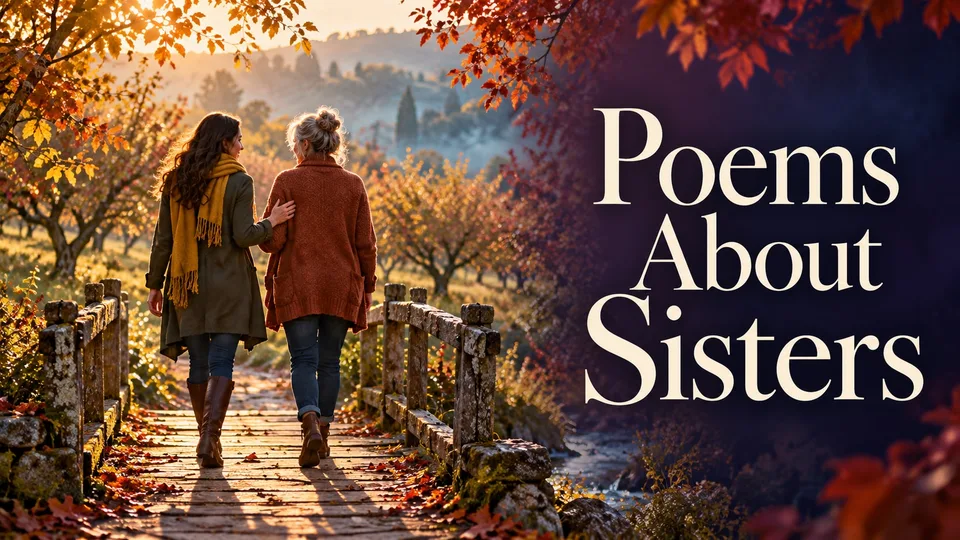
There are family stories that a sister can begin with half a sentence. Someone mentions the room with the blue curtains, a borrowed sweater, or the afternoon a game became an argument, and a whole younger world returns. The details may be small, but they belong to a history that cannot quite be explained to anyone else.
These seven original poems about sisters follow that history into adult life. They include a thank you for an older sister, a little humor about sharing, and poems about letting one another grow in different directions. One also welcomes a sister who joined the family later, because a shared beginning is not the only way a family bond can take shape.
I like poems that can hold affection and difference together. Sisters do not need matching personalities, identical memories, or the same plans for the future to find something worth keeping between them. Sometimes the most generous thing is to stop expecting a person to remain the child you remember.
Use these poems for a card, a family gathering, a memory book, or a note that has been waiting for the right words. Choose a piece that fits the relationship you actually have. One true memory in your own handwriting will make the poem feel nearer than a claim of closeness you do not recognize.
For a birthday message, these funny birthday poems for a sister focus on the celebration itself. These poems celebrating sisterhood and female friendship explore the wider circle of women who become sisters through friendship.
Find a Poem for Your Sister
| Poem | A good fit |
|---|---|
| The Games We Remember | Shared childhood memories |
| First Through the Door | Thanks to an older sister |
| The Message Without a Reason | A short personal note |
| Dividing the Bun | Gentle sibling humor |
| We Do Not Have to Match | Sisters with different lives |
| A Sister Who Arrived Later | A family bond that began later |
| The Blue Chalk Line | Childhood disagreement and affection |
Seven Poems About Sisters
The Games We Remember
The blanket fort and the chalk marks give this poem somewhere concrete to return. I like that remembering childhood does not require the sisters to remain inside it. The repeated lines can become a shared reading when both people enjoy looking back at their younger selves.
You know the games we used to stop and play.
The whispered plans that filled the room at night.
Some part of childhood walks with us today.The chalk we left for rain to wash away,
The blanket fort we guarded out of sight.
You know the games we used to stop and play.The things we swore we never meant to say,
The first brave words that helped to set things right.
Some part of childhood walks with us today.The years have led us out a different way,
Yet one old joke can make the evening bright.
You know the games we used to stop and play.We let each other change from day to day.
We need not hold our younger selves too tight.
Some part of childhood walks with us today.Though other voices fill our hours today,
I know the laugh that finds me in the night.
You know the games we used to stop and play.
Some part of childhood walks with us today.
First Through the Door
An older sister may learn a path before the younger one is ready to try it. What moves me is the balance between gratitude and the wish to have a life of your own. This poem thanks someone for going first without making her responsible for every step that follows.
You went before me through the classroom door,
The playground gate, the corner of the street.
You learned the map a little while before
I had the nerve to trust my growing feet.At times I wore the coat you had outgrown
And wished the world would let me have my say.
You could not walk the roads that were my own,
But showed me I could find another way.Now life has rooms that neither one has seen,
And questions that can make us start anew.
We leave a little growing space between
Your life and all the things I hope to do.I know the gift of someone by my side
Who went ahead and held the doorway wide.
The Message Without a Reason
I am fond of a message that does not arrive with an obligation attached. It leaves the recipient free to smile and continue with the day. These short lines could accompany a photograph, an old joke, or a detail that made you think of your sister.
Nothing has happened.
I do not need advice.
I saw something blue
in a shop window
and thought of the curtains
we insisted were the sea.I wanted to tell
the other person
who lived beside
that particular ocean.
Dividing the Bun
The careful division makes me smile more than an argument would. Both sisters intend to be fair and still have an interest in the result. This is a small, affectionate joke for siblings who recognize the negotiations that can gather around one remaining treat.
Two sisters were eyeing one bun.
Each said, I could manage that one.
They split it with care,
Then stopped to compare
Whose half was the bigger, for fun.
We Do Not Have to Match
The city and the fields give each sister a place to be herself. I value the speaker's wish to remain interested rather than insist on agreement. It makes a thoughtful message when two adult lives look different but the affection between them still matters.
You love the city waking into sound,
I like the fields before the morning sun.
Our roots may seek a very different ground,
And neither life must be the only one.We need not take the same advice to heart
Or see the world in quite the same clear light.
Our different tastes need never pull apart
The love that lets us both be wrong or right.I want to know the life that makes you glad,
The plans you make, the friends you hold most dear.
And if the day is difficult or sad,
You need not change your voice to reach me here.We share a past; the future can be wide,
With room to walk, and love on either side.
A Sister Who Arrived Later
Some sisters enter one another's lives after the first family photographs have already been taken. I wanted to leave those beginnings their dignity while welcoming something new. The affection in this poem is built through what the two people choose to do now.
We did not share the house where I was small
Or learn the same old names for every room.
Your childhood has a window of its own.
I will not ask its light to match with mine.
But here we are, with stories still to tell,
With space to make a habit of a call.
A family can grow another branch
Without erasing where its roots began.
The Blue Chalk Line
A chalk border can seem very important until the room grows dark. I like the way the sisters keep their separate little kingdoms and still make a place for comfort between them. It is a childhood story about closeness finding its own way across a boundary.
We drew a line across the room
To show whose half was whose.
Your books remained upon your side,
And mine began with shoes.It lasted till the lamp went out,
And thunder shook the pane.
You moved your pillow past the chalk
And said, Here comes the rain.By morning, shoes had crossed the line,
Your book was by my bed.
We kept our little kingdoms, but
Made room for us instead.
Let the Note Belong to Both of You
Before sending a poem, think about the sister who will receive it. Would she enjoy an old family memory, a quiet thank you, or a joke that does not need explaining? Choose the tone she would recognize rather than the one that seems most impressive on a greeting card.
If a poem reminds you of an actual event, name that event in a sentence beside it. You can write, “This brought back the room we tried to divide,” or describe something entirely different from your own history. The point is recognition, not matching every detail in the verse.
For sisters who live far apart, a small message can be easier to receive than a large promise about getting together. Send the photograph you found. Ask about the project she mentioned. Let an ordinary conversation count, even if neither of you has a remarkable story to report.
And if your memories differ, leave room for the difference. The same childhood can look unlike itself through another person's window. I think affection becomes more generous when it can say, “Tell me how you remember it.” A sister is someone you may have known for years, and still someone worth getting to know again.
Send a little poetry to someone you love.