

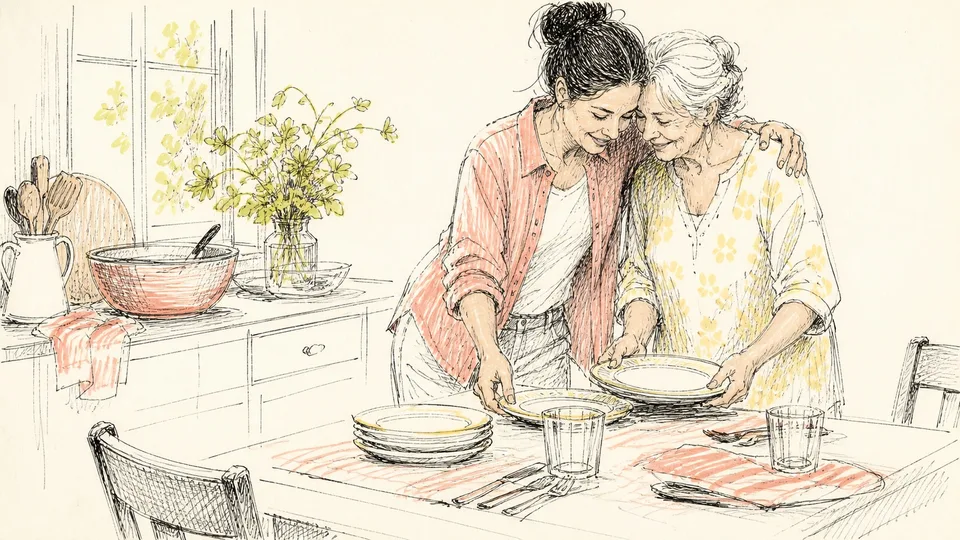
Love for a mother is often easiest to recognize in the work that once seemed ordinary. It may be a lunch packed before daylight, a patient answer to the same question, or a place kept at the table when the day ran long. Years later, those details rise with surprising clarity and ask to be named.
These poems about love for mother are for a card, a visit, a family gathering, or a private moment of gratitude. The collection includes two sonnets, blank verse, a haiku, and a ballad. Some pieces speak from an adult child, while others simply notice the steady forms that care can take.
No family story is perfect, and a sincere poem does not need to pretend otherwise. Gratitude can be honest about hard seasons while still honoring patience, humor, sacrifice, and growth. The most useful words are often the ones that describe one true kindness instead of making a grand claim.
For an occasion centered on her, you may also find a fitting message among these poems for a mother’s birthday or Mother’s Day. The thank you poems for Mom offer another path when gratitude is the main feeling you want to express.
Five Poems of Gratitude and Love for Mother
The Work Beneath the Morning
This sonnet honors the tasks a child may not notice until much later. Its love lives in preparation, repetition, and the quiet decision to begin again each morning.
Sonnet
Before the sun had reached the kitchen pane,
You filled the cups and set the bread to rise;
You heard our hurried worries once again,
Then met the morning with attentive eyes.
The buttons fastened, lunches found their place,
A missing page was rescued from the floor;
No trumpet sounded for that daily grace,
Yet love went walking with us through the door.
I did not know what all that labor meant,
Or how a weary hand could still be kind;
The years have shown what every gesture sent,
A steady shelter carried in the mind.
I name it now, the gift I could not see,
Your faithful work became a home for me.
What Your Hands Remember
Hands can carry a family history without saying a word. This sonnet looks at cooking, mending, gardening, and comfort as parts of one long language of care.
Sonnet
Your hands know how to test the garden ground,
And smooth a collar ready for the day;
They turn a wooden spoon without a sound,
Then brush a worried strand of hair away.
They marked the books that taught me how to read,
And held the bowl while I first learned to stir;
They planted more than any single seed,
For patience grew wherever your hands were.
The skin is softer now, the fingers slow,
Yet still they fold a napkin straight and square;
I take those hands and hope my own can show,
The half of all the love I gathered there.
No speech could hold the lessons they impart,
Your working hands have written on my heart.
A Chair Beside the Table
This blank verse piece considers welcome as a form of love. The mother in the poem does not solve every trouble, but she makes a place where truth can be spoken without hurry.
Blank verse
You pulled a chair beside the kitchen light,
And let the kettle answer while I spoke.
The rain kept drawing rivers on the glass.
You did not hurry sorrow from the room.
You listened till the hard words lost their weight.
Then placed warm bread between us on a plate.
No perfect answer waited in your hand.
Your gift was making time enough for truth.
I left with rain still silver on the road,
Yet carried quiet shelter in my chest.
Her Garden Apron
This haiku holds one familiar object and the care attached to it. A small cloth pocket can preserve the scent of herbs, soil, and a morning spent together.
Haiku
Her garden apron
Holds mint leaves and morning sun
Home clings to the cloth
The Recipe in the Margin
Family recipes often carry notes that matter more than perfect measurements. This ballad follows a penciled instruction from one kitchen to another and finds a mother’s voice still offering calm help.
Ballad
I found your recipe one day,
With flour along the fold;
“Add patience here,” the margin said,
In pencil faint and old.I warmed the bowl, I stirred it slow,
And watched the batter shine;
The kitchen filled with years ago,
Yet still the room was mine.I served the cake on Sunday plates,
While children gathered near;
Your quiet note beside the dates
Made every measure clear.
Saying What Daily Love Has Meant
A poem for a mother becomes more personal when it notices what only you would know. Perhaps she always kept a safety pin in her purse, called at the right hour, or left the porch lamp on when someone was late. Perhaps her best gift was not an object at all, but the way she listened before offering advice.
Choose a poem here as a beginning, then add one honest sentence of your own. “I still think of the way you…” can open a memory without requiring a polished speech. If the relationship has known strain, gratitude can remain specific. You can honor a lesson, a repaired season, or one kindness that truly helped without pretending every chapter was easy.
Love also changes as a mother grows older and an adult child begins to offer care in return. The direction may shift, but the bond does not become a debt ledger. It becomes a practice of attention. We learn to notice what she needs, to ask about her stories, and to sit long enough for the second cup of tea.
The deepest thank you may be lived over time. It appears in a returned call, a shared meal, a patient visit, or a family habit carried forward with tenderness. Words matter, especially when they are sincere. Yet words become even warmer when they are followed by the same kind of steady care they celebrate.
Send a little poetry to someone you love.