

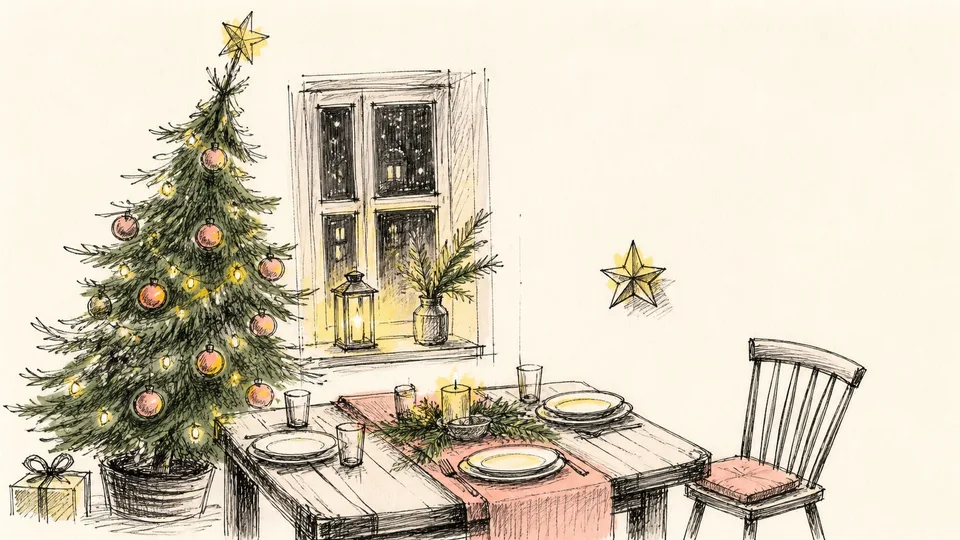
Christmas can hold many rooms at once. There is the bright room of children and paper, the quiet room of faith, the crowded kitchen, and the inward room where absent people are remembered. A meaningful Christmas poem does not have to choose only one.
These poems about Christmas include two sonnets, a ballad, a haiku, and blank verse. They move from a winter window to a family table, then toward generosity, wonder, and the sacred hush some readers carry through the season.
I am fond of celebrations that show their seams. The cookies may brown at the edges, someone may arrive late, and the tree may lean toward the window. None of that diminishes the welcome. Love rarely waits for a perfect setting before it comes inside.
If you need a playful group activity, these left right gift exchange poems for Christmas offer a livelier direction. For words to a spouse, you may prefer these Christmas poems for a wife.
Read the collection with your own tradition in mind. You might place a poem in a card, share one before a meal, or use a few lines to begin a personal message. Let the poem support the gathering rather than compete with it.
Poems About Christmas
The Window in December
This Shakespearean sonnet follows an ABAB CDCD EFEF GG rhyme pattern. A glowing window becomes a promise of welcome in the deepest part of winter.
The winter presses softly at the pane,
While lamplight settles gold across the floor,
A traveler turns from fields of silver rain,
And sees a wreath beside an open door.Within, the kettle answers with a song,
The coats are piled, the old green branches shine,
A chair is drawn for one who stayed too long,
A hand sets out another cup of pine.No house can keep all sorrow from the cold,
Or wrap each memory in a ribbon bright,
Yet welcome is a shelter we can hold,
A human flame against the longest night.Come in as you are, weary from your quest,
The Christmas window offers warmth and rest.
The Ballad of the Crooked Tree
This ballad uses regular four line stanzas and a simple story. Its leaning tree reminds a family that delight does not require symmetry.
We brought the crooked cedar in,
It leaned toward the chair,
We turned it east, we turned it west,
It still looked happy there.The children hung the stars too low,
The silver thread came loose,
A paper angel lost one wing,
A bulb rolled by the spruce.We stepped away to judge our work,
Then someone gave a cheer,
For every branch held something loved
From many passing years.The tree stood crooked through the night,
More faithful than refined,
And taught us joy may lean a bit,
Yet leave no heart behind.
Snow Before Morning
This haiku holds the season in a quiet outdoor image. Its five, seven, five syllable pattern leaves room for a reader to bring their own sense of wonder.
Snow softens the lane
One porch star waits through the dark
Dawn opens its hands
What the Manger Light Reveals
This Petrarchan sonnet uses an ABBA ABBA octave and a six line resolution. It approaches the Christmas story through humility, shelter, and a light offered to ordinary people.
No palace held the wonder of that night,
But straw, close breath, and shelter from the cold,
A child received by faithful arms that hold,
While watchers raised their faces toward the light.The proud may seek a throne of polished height,
Yet grace arrives where little wealth is told,
And asks no jeweled gate, no roof of gold,
To make a humble room forever bright.So let my celebration make a place
For weary feet, for hunger, and for need,
Let every gift become a form of grace,
And every welcome grow beyond the creed.The holy light is more than what we see,
It asks what love will give through you and me.
The Extra Place
This blank verse poem uses measured, unrhymed lines. It centers the practical generosity of making room for someone who might otherwise spend the holiday alone.
We lift the folded table from the wall.
One more white plate is set beside the green.
The narrow room grows wider through the act.
A neighbor brings a pie still warm from home.
We do not ask for stories she withholds.
We pass the bowl and let the silence rest.
Soon laughter finds the ribbon on her sleeve.
The candles shorten while the evening grows.
No grand announcement names what happened here.
One extra place became a gift for all.
Making Room for the Whole Holiday
Christmas poetry can be bright without ignoring loneliness. Many people enter the season carrying grief, distance, financial strain, or a family situation that does not match the pictures in shop windows. A gentle poem leaves room for those truths and does not command anyone to feel merry.
The Window in December offers welcome to someone arriving tired. The Crooked Tree works for a family gathering where humor is part of the affection. Snow Before Morning fits a small card. What the Manger Light Reveals can be shared in a Christian setting, while The Extra Place suits a community meal or a note of gratitude.
When you personalize a poem, name one tradition that genuinely belongs to your people. It might be a certain dish, a song sung too loudly, a drive beneath familiar lights, or the ornament that always hangs near the bottom. Such details keep a holiday message from sounding borrowed.
Generosity also needs no expensive wrapping. It can look like a ride, a meal, an afternoon call, or patience with a person who finds the season difficult. Often the most memorable gift is the sense that there was room at the table and no test at the door.
The lights will be packed away, and the tree will leave a scatter of needles. What can remain is the welcome we practiced. If Christmas teaches the heart anything, I hope it is this: warmth grows when it is shared, and even a small light can help someone find the way home.
Val’s favorite Christmas decorations
These research picks bring a little light and greenery to a holiday gathering. Start with decorations you already have; a welcoming table needs no new purchases.
These are paid links. As an Amazon Associate I earn from qualifying purchases.
- View on Amazon
National Tree Company Crestwood Spruce Garland
Add greenery to a mantel shelf or stair railing for a Christmas reading or family gathering. This plug-in version needs an outlet; follow its placement instructions and keep it clear of heat.
One 9-foot pre-lit garland, plug-in version
- View on Amazon
Homemory flameless tea lights
Arrange small lights in existing votive holders or along the table for an evening reading. Adults should handle the lights and keep the button batteries away from children and pets.
12 warm-white LED tea lights with installed CR2032 batteries
Send a little poetry to someone you love.