

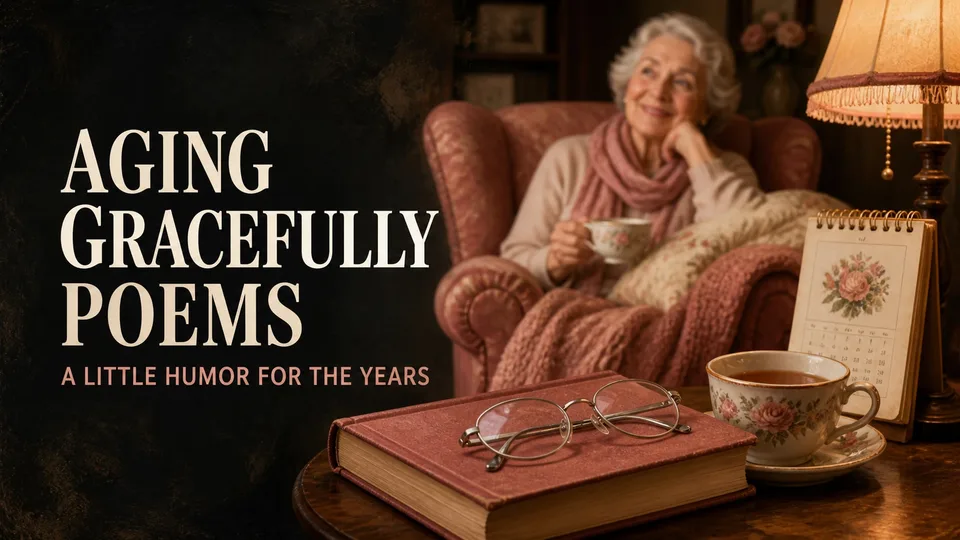
Aging gracefully does not mean pretending that every change is elegant. Sometimes grace looks like laughing at the reading glasses on your head, choosing comfortable shoes, and letting a younger person carry the heavy bag. These funny poems about aging gracefully celebrate humor, self respect, and the pleasure of knowing what matters.
For a reflective companion, you may enjoy poems about a life well lived or poems about strength. Keep the humor aimed at shared human experiences rather than anyone’s private health or appearance.
Funny Poems About Aging Gracefully
The Glasses on My Head
This poem uses a familiar search for reading glasses as a gentle joke. It avoids making memory loss the punch line. The humor comes from a harmless household discovery.
I searched the house for reading glasses,
I searched the hall and bed.
I found them resting quietly
Upon my very head.I thanked the room for giving them,
The room remained quite still.
Good glasses know the best place to
Wait for their own will.
The Chair Has My Name
This poem treats a comfortable chair as a trusted companion. It celebrates rest without making it a defeat. The image suits a birthday card or reading group.
The chair has learned my favorite shape,
It knows where I will sit.
It holds my book, my tea, my shawl,
And does not question it.The world may ask me to go out,
The chair says, Stay awhile.
A graceful age includes a place
To rest and find a smile.
Silver in the Mirror
This poem makes room for changing hair with warmth. It does not suggest that one appearance is better than another. The silver becomes a record of lived time.
The mirror found some silver strands
And placed them in my hair.
I asked if they were permanent,
It said, They are now there.I cannot argue with a mirror,
Or make the years reverse.
I can wear my little stars with pride
And laugh about the first.
The Early Bird Changes Plans
This poem gently reverses the idea of the early bird. It celebrates choosing sleep and slow mornings. The humor is kind for anyone who has learned to value rest.
The early bird can have the worm,
I wish it well at dawn.
I have a warm and sensible bed,
And plan to linger on.The sunrise will not mind at all,
The day will still appear.
A graceful age may start with sleep
And end with better cheer.
My Knees Prefer a Story
This poem notices that the body may ask for a pause. It turns that pause into a chance to read and think. The result is humorous without making discomfort the whole story.
My knees prefer a story
To a hill they used to climb.
They say a book can take me far
Without a travel time.I thank them for their honest view,
Then turn another page.
A body has its own ideas
About a graceful age.
The Calendar and I
This poem gives the calendar a personality. It recognizes that dates can bring both memory and surprise. The final lines choose curiosity over worry.
The calendar keeps counting,
It does not ask my view.
I tell it that I have some plans
And some naps to schedule too.The years may write their numbers down,
The days may change their pace.
I will keep adding laughter to
The margins of the page.
Grace with a Sense of Humor
This closing poem gathers the collection into a generous definition of grace. It allows for mistakes, naps, and laughter. The ending is warm enough for a celebration of any age.
Grace is knowing when to rest,
When to ask for help.
Grace is laughing at the joke
You make about yourself.The years can bring a deeper view,
A kinder way to see.
Growing older with a smile
Is good enough for me.
Funny aging poems should make the reader feel included rather than exposed. Choose common household moments, and let the final lines honor the person’s dignity and experience.
Send a little poetry to someone you love.