
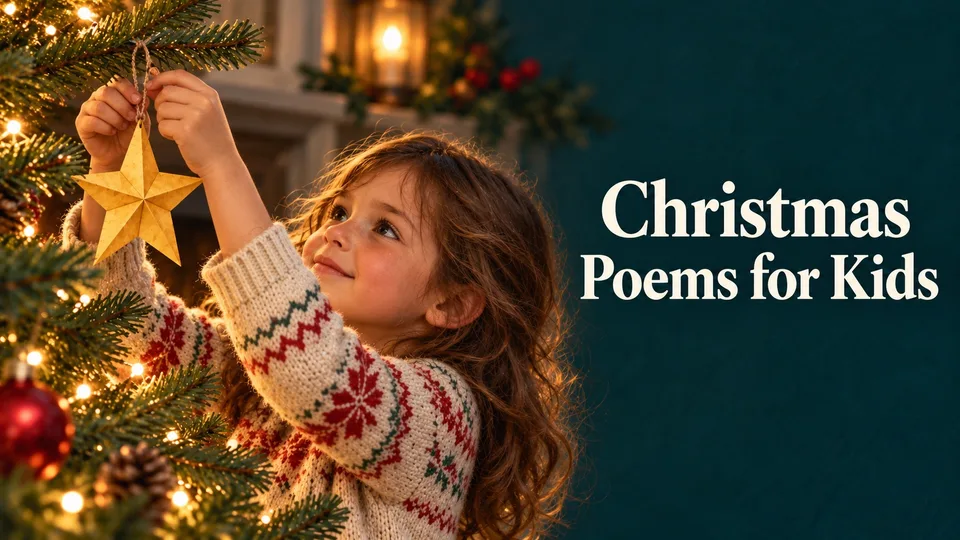
A paper star hung on a low branch can be the most important decoration in the room. The child who made it knows where the corner tore and which side has the extra glue. I like leaving those marks in place. They tell us that somebody small had a real part in making the holiday.
These Christmas poems for kids offer eight original readings about winter wonder, Santa's uncooperative mittens, giving, and time spent together. The first three are brief choices for preschool and kindergarten with an adult. The next four give early elementary and older children fuller stories and shared readings. The final poem is a separate, optional Christian Nativity reading for a setting where that story is welcome.
The age suggestions are flexible, rather than a test of how a child should read. Some children will enjoy a poem independently; others may want a grown person beside them. A hand motion, a repeated line, or simply listening can all be ways to join. Let the reader choose what feels comfortable.
For a quick beginning, try “A Snowflake Visit.” For a small laugh, choose Santa's missing mitten. The longer readings include handmade gifts and a child who offers time instead of something bought. If you need a few lines for an actual greeting card, my short Christmas poems offer more choices by recipient. Here, we will let children imagine, notice, and share a little of the season in their own voices.
Three Short Poems for Younger Children
A Snowflake Visit
That brief white visitor does not stay long enough to be kept. I like the poem as a quiet beginning, with children imagining something small before moving into a busier holiday story.
Haiku. Preschool and kindergarten with an adult.
Snowflake on my sleeve
One small star has come to rest
Then it slips away
Hold out an arm for the first line, open a hand for the star, and gently close it at the end. Children can watch the motion instead of making it themselves.
Santa's Missing Mitten
Santa has found the right color and the wrong object, which is the little mistake I enjoy here. I would pause before the last line so children have time to picture the sock trying to become a mitten.
Limerick. Preschool and kindergarten with an adult.
Old Santa went looking for red
In the mittens he'd left by his bed.
He found one in sight,
Put it on with delight,
Then discovered a sock there instead.
Pretend to search a pocket, then lift one hand as though checking a mitten. This is a playful imaginary Santa story, so the motion can be as simple or silly as the group likes.
The Gift I Can Give
The little gift begins with something the child already has: a few minutes and a place to sit. I appreciate that choice because it lets giving belong to a child without requiring money or a large project.
Free verse. Younger children with an adult or a confident early reader.
I can bring my favorite book.
I can sit beside you.
I can turn the page slowly
so you see the picture, too.
My present takes no ribbon.
It takes a little time.
Ask children to think of something kind they could do with another person. Accept a small, concrete answer rather than asking them to promise a whole holiday of helping.
Four Readings for School and Shared Family Time
The Little Paper Star
The tree gives a small handmade star a place beside its brighter decorations. I like the child's quiet satisfaction at the end, which does not depend on making the largest or neatest ornament.
Ballad. Early elementary readers or an adult sharing the story.
I made a little paper star
And colored it with gold.
One corner tore; I mended it,
And watched the glue take hold.We hung it on a waiting branch,
Where I could see it shine.
The tree had many lovely things,
But that small star was mine.
Children can point to an imaginary star on the last line. A drawing or a paper shape can accompany the reading, without needing to become a competition for the prettiest decoration.
A Little Light to Share
The returning lines give a group something simple to offer together. I like the welcoming gestures between them, especially the friend finding a place in a game that is already underway.
Villanelle. One lead reader with a group joining the two returning lines.
A little light is something we can share.
A friendly word can warm a winter day.
We make a place for kindness everywhere.We bring a book and set a little chair.
We ask a friend to join us in our play.
A little light is something we can share.A paper star can flutter in the air.
A patient hand can help it find its way.
We make a place for kindness everywhere.The smallest gift can show a little care.
A quiet voice can have a thing to say.
A little light is something we can share.We lift a coat and set it on a chair.
We help to put the finished paints away.
We make a place for kindness everywhere.A friend can rest; we bring a blanket there.
The room has space for quiet, too, today.
A little light is something we can share.
We make a place for kindness everywhere.
The Lowest Branch
I notice how much care the child gives a branch that is easy to overlook. The poem offers an older reader a fuller story about helping, while keeping its attention on something a younger child can picture.
Sonnet. Older children or an adult reading aloud.
The lowest branch is waiting for my star;
I do not need a ladder for its height.
The topmost bells are shining from afar,
But here my hands can set a small thing right.
I tie the string and let the paper swing;
One corner curls and brushes past my shoe.
The branch has room for every little thing
That patient hands have helped to make or do.
I step away to see the golden square
Of light that falls beneath the waiting tree.
My star has found a bit of winter air,
And made the lowest branch belong to me.
A place within my reach can hold its part,
And shine with all the work of one small heart.
A Present Made of Time
The present has no wrapping because it is a visit and a shared book. I like that this child can make a generous choice without being responsible for solving somebody else's whole day.
Sonnet. Older children or shared family reading.
I cannot buy a shining silver ring,
Or wrap a grand surprise in paper blue.
But I have half an hour that I can bring,
And one good book to read aloud to you.
We choose a page with pictures of a boat;
I hold it where the window makes it bright.
You point to where a little ship can float,
And help me read a word I can't get right.
The clock goes round; the paper gifts can wait.
We follow painted rivers to the sea.
A story gives our afternoon a gate,
And opens up a place for you and me.
My present has no price upon its lid;
Its worth is in the little thing we did.
One Optional Christian Nativity Reading
This selection draws on the birth of Jesus and the visit of the shepherds described in Luke 2. Choose it for a church program, family worship, or another setting where a Christian reading is appropriate.
The Manger
The careful wrapping gives this little reading its gentleness. I like beginning with the care of a child before letting the scene widen to the shepherds and their joyful news.
Blank verse. An adult or supported child reader in a Christian setting.
A mother wraps her little son in cloth.
She lays him in a manger for his rest.
The shepherds come to see the newborn child.
They carry joyful news beyond the room.
Helping Children Find Their Own Reading
I would begin by letting a child hear two short poems, then choose which one they like. A child may choose the snowflake because it is quiet or Santa because the sock makes them laugh. Both are good reasons to return to a poem. Enjoyment can come before an explanation of form.
For a school program, rehearse a clear beginning and a comfortable ending. Children can share a returning line, hold a handmade star, or listen with the group. Leave a place for anyone who changes their mind about speaking. A holiday reading should help a child feel included, rather than watched for mistakes.
The sonnets are fuller readings for older children or a grown person to carry. Afterward, ask for one image that stayed with the listeners. It might be the low branch, the boat in the book, or the clock moving while two people sit together. Nobody needs to explain every line to have met the poem.
Keep the optional Nativity selection distinct when planning a program. The Christian Christmas poems offer more readings for a church or worship setting, while the other selections here focus on holiday imagination, giving, and winter wonder.
I hope these poems give children a small piece of the season they can call their own. A paper star, a funny sock, or a book shared slowly can be enough. Let the reading leave room for their particular voice, including the pauses and imperfect corners that make it theirs.
Useful supplies for a handmade paper star
For parents and teachers: start with scrap paper and glue already in the cupboard. A handmade star can accompany the reading without needing new decorations.
These are paid links. As an Amazon Associate I earn from qualifying purchases.
- View on Amazon
Elmer’s Disappearing Purple School Glue Sticks
Attach paper pieces to the handmade star a child can hold during the group reading.
Six washable glue sticks, 6 grams each
- View on Amazon
Astrobrights white cardstock
For grown-ups preparing the activity: make sturdy paper stars or a page for a child’s poem and drawing. Check cardstock printer settings before printing.
75 white U.S. Letter sheets, 8½ × 11 inches, 65 lb
- View on Amazon
Crayola Crayons
Color the star or drawing with crayons children already know how to use.
Two boxes of 24 crayons, 48 crayons total
Send a little poetry to someone you love.